Snowstorms
(12/01/2011)
It’s been quite a winter so far. This morning, winter storm warnings blanket New England as the second major tempest–a true blizzard near Boston–in a little over two weeks mounts a furious assault. It’s already dropped 6 to 12 inches on NYC.
Winter storm warnings are also in effect for much of Washington state, northern Idaho and northwest Montana. Wind chill advisories cover the Great Plains and portions of the Midwest. Hard freeze warnings are a dime-a-dozen in the Deep South.
Where I live, near Atlanta, things remain at a virtual standstill after Sunday night’s crippling snowstorm. No mail. No newspaper delivery. No trash pick up. No school. Oh, and two of Atlanta’s eight plows reportedly collided with each other yesterday. At this rate, it may be St. Paddy’s Day before things return to normal here.
A question I’ve been asked is how do we–meaning meteorologists, both working and retired–know these nasty storms are coming? Forecasting snow, especially in Dixie, has always been fraught with peril. And yet this year, the computer models have been able to hone in on these things with laser-like intensity.
There are two global weather forecasting models on which meteorologists rely most heavily: the European Center for Medium-Range Weather Forecasting (ECMWF) model, or “Euro” as we mets call it, and the U.S. model known as the Global Forecast System or GFS. All of us weather guessers, working or not, have access to these models via the Internet.
Both the Euro and GFS have been pretty darned good recently, although the Euro seems to catch on to developing events a little quicker than does the GFS.
Case in point: the chatter by forecasters on Facebook about Sunday night’s impending snow blitz in Atlanta actually began the previous Wednesday. The Euro was the “canary in a coal mine,” raising the specter of a big winter storm for the Deep South. Meteorologists don’t go public with this sort of talk, since we know way too much can “go wrong” so far in advance.
But by Friday, all the models were singing from the same sheet of music. What had begun as a few glowing embers of discussion on Wednesday had exploded into a full-fledged wildfire on the Internet by Friday.
Although much of the public was aware something big was brewing, many people remained oblivious. Here’s a story that illuminates that. At my stepdaughter’s request to keep her apprised of developments, I sent the following email to her at the large law firm where she works in Midtown, thinking it would be for her eyes only:
Looks like this should be the biggest winter storm in ATL since Superstorm ’93. My guess is the metro area will be at a virtual standstill Monday. Still looks like a late afternoon or early evening start Sunday with maybe 3-5 inches of snow and sleet overnight, topped off by a little light icing…. No rapid warmup after this, so the roads will likely remain a mess for much of the coming week.
It turned out the message got much wider dissemination than I ever intended it to have.
My daughter showed it to her boss who thought it was a joke. He even checked on Snopes.com. Lawyers. Anyhow, convinced the forecast was legit, contingency plans were made to deal with Old Man Winter’s shenanigans Monday and beyond. My stepdaughter says I became a “hero” around the office. But the story doesn’t end there.
She forwarded the message to her father who works at a local Walmart, He showed it to his boss who said, “Wow. I hadn’t heard about this. Maybe we’d better lay in some extra bread and milk.”
Ya think?
Anyhow, based on the early red-flag waving of the Euro model, my wife and I gathered our storm supplies on Wednesday and Thursday. “Let’s beat the stampede,” I told her.
So, is there more winter nastiness in store for the Southern states? Beats me. But given what seems to be a persistent pattern and the fact we haven’t even reached mid-January yet, I wouldn’t bet against it.
Eight plows?(11/01/2011)
To say this has been an interesting winter so far would be a healthy understatement. As I write this, the largest city in the South remains wrapped in a blanket of white and virtually shut down for the second day in a row. What little traffic there is creeps like a garden slug on a dewy morning. And the busiest airport in the world isn’t boasting any more action than the airstrip at Barrow, Alaska.
This is Atlanta’s third bout with winter weather this season–and by far the most crippling. The last time the metro area was blitzed by this much snow was in March 1993–the infamous Superstorm. That near-blizzard blew in on a weekend, however, and within a couple of days Mother Nature in all her spring finery had repatriated the city.
That won’t happen this time. Temperatures will struggle above freezing today, but then plop back down to polar levels for the remainder of the work week. So I trust Atlanta’s eight (that’s the number I’ve heard bandied about most often) snowplows can get ahead of the game today. Otherwise….
Eight plows? Well, I understand the economics. If they’re called to active duty only once or twice every few winters, it doesn’t make any sense to have a standing army of them. But it is kind of laughable when contrasted with New England (where I used to live).
I watched a live shot on The Weather Channel from Natick, Massachusetts during the post-Christmas snowstorm. While Mike Seidel was doing his shtick, NINE plows in a row streamed by on the road behind him. Nine plows in about two minutes! That’s the reason it’s always been my contention you could get by in New England without snow tires if you didn’t have to drive during or immediately after a storm.
That theory will be tested for the second time this winter as another major NYC/New England snowstorm brews and bubbles this morning. The remnants of our Southern nemesis are expected to join forces with a wintry system sweeping eastward out of the Midwest to produce another whopper of a bopper along the I-95 corridor in the Northeast.
More thoughts and observations, and an anecdote about forecasting, tomorrow.
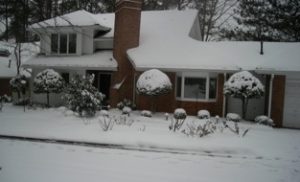
Photo: North side of Atlanta
A half foot of snow and ice–the biggest winter storm in Atlanta since Superstorm in March 1993–brought the city to a slip-sliding halt Monday. It may be the weekend before things are back to normal.
(28/01/2010)
As I write this, bitter cold arctic air is slashing eastward and southward across the eastern two-thirds of the nation, and a pugnacious winter storm is aborning over the Southwest. Thus, the stage is set for a blitzkrieg of ice and snow from New Mexico to North Carolina over the next 48 hours.
Curiously enough, the storm comes almost exactly a year after a devastating bout of ice and snow assaulted roughly the same area. The 2010 version, however, will end up focusing its fury just a bit farther south. After punching New Mexico, the Texas Panhandle and Oklahoma hard, the system will throw crippling haymakers at large chunks of Arkansas, Tennessee and North Carolina.
So, rather than continue with my series on extended-range forecasting, I’m going to break continuity here and present another piece from my unpublished manuscript INSIDE THE WEATHER CHANNEL. This segment addresses alleged “scaremongering” by the channel and uses the 2009 ice storm as a case-in-point.
On Sunday morning, January 25, 2009, I sent a strongly-worded email to key members of The Weather Channel’s production staff. In the message, I, in my capacity as a Lead Meteorologist, warned that a major ice storm loomed for a large swath of the country. Not only should the channel be headlining the developing storm, I said, but in all likelihood we’d need multiple teams in the field to cover it.
A fresh slug of bitterly cold air had punched into the northern Plains, where temperatures had tumbled to subzero levels, and bridged across the Midwest into New England. South of the frigid air mass, moist Gulf of Mexico air was poised to surge northward. Over the Southwest, a series of upper-air disturbances was taking aim on the impending clash of air masses in the central U.S. It was an unusually potent situation.
Stu Ostro, Senior Director of Weather Communications, saw it coming, too, and blogged about it on The Weather Channel’s Website 24 hours later. “The places that get the largest amounts of precipitation,” he wrote, “and of which most is freezing rain, will have a serious ice storm capable of producing power outages which are widespread and last for days; the greatest threat is in a swath from northern Arkansas into Kentucky….”
He nailed it. Northern Arkansas and Kentucky indeed took the brunt of the storm over the course of January 26 to January 28. In Kentucky alone, over 700,000 homes lost power at the height of the storm. Overall, the storm assaulted an area that extended from Texas to New England. At least 42 people lost their lives as a direct result of the icy fusillade; 1.3 million customers found themselves without utility services. Dark and cold.
Most people no doubt appreciated The Weather Channel’s red flag waving, at least they should have. But there’s always a few…. Here’s an email Stu got in response to his blog: “Stew [sic]–why do you insist on being a scaremonger? Just curious. Do they make you do it?” (Whoever “they” is.) It’s my senior citizen’s crankiness coming out, but I hope this guy was cooking beans over a Bunsen burner for a week after the storm. Alas, he probably lived in Florida.
No one, not even NBC, orders Weather Channel meteorologists to hype anything. In fact, forecasters have been known to get bent out of shape when producers occasionally get happy feet with hyperbolic headlines. But the January 2009 ice storm was one that would have been hard to blow out of proportion.
The wintry onslaught was well forecast not only by the channel but by the NWS, too. The network isn’t in competition with the NWS, by the way; there’s a hand-in-glove synergism that exists. The Weather Channel relies on data and technical guidance provided by the NWS through the Hydrometeorological Prediction Center. The NWS, in turn, counts on the channel to disseminate weather watches and warnings, which are all government-issued, on a national scale.
While no one at the channel pressures meteorologists to be “scaremongers,” there is implicit pressure to “get it right.” And that pressure isn’t so much external as internal. Another name for it is professional pride.
I remember poring over models and discussions prior to transmitting my Sunday email and outlining a rather broad area where I thought icing would be particularly nasty. My counterparts at the Hydrometeorological Prediction Center came up with pretty much the same outlook. Thus, I felt quite confident when I sounded the alarm for a major ice storm and extensive power outages. Stu, at home that day, performed his own analysis and concurred with my warning.
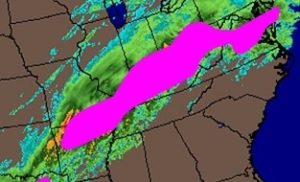
Photo: January 2009 Ice Storm
This image, from WeatherTAP.com, shows the expansive precipitation associated with unseasonably warm air overrunning a sprawling cold air mass late on January 27, 2009.
Stu Ostro of The Weasther Channel added the hot pink color showing locations where freezing rain was falling. (Snow is not depicted.)
The reach of the freezing rain (icing) is vast, extending from northern Texas to eastern Virginia on the Delmarva Peninsula.
Sack and Pillage Alert(03/01/2010)
All one has to do in the Deep South is mention “snow” or even “snow flurries” in a weather forecast, and it’s a given that residents will descend upon local grocery stores like barbarian hordes. All milk and bread will disappear from shelves within 12 hours. The sacking of Kroger. The pillaging of Publix.
Now, before you read any further, I must issue a caution: please keep in mind the Bernard Three-Day Theorem which states “never make or alter any plans based on a weather forecast beyond 72 hours into future.” Despite the proliferation of modern technology and computerized tools, that’s what this ancient meteorologist has learned the hard way a number of times.
Having said that, let me now state that the meteorological set up for snow toward the end of the week in parts of the Deep South (the northern halves of Mississippi, Alabama and Georgia including Atlanta) is about as good as I’ve seen in over 20 years of weather watching in Dixie.
It’s tough to get meteorological conditions–the requisite amounts of cold air and moisture–to come together to produce snow in this part of the world. Which is why, obviously, it doesn’t snow much in the land of Mint Juleps and magnolias.
But with a frigid air mass in place and not going anywhere, and at least a small storm expected to bubble up along the Gulf Coast, the table is set. Bring on the barbarians. And maybe at least try to remember where you stowed your snow shovel. (It’s that thing with a broad, flat scoop on the end of a long handle.)
Anyhow, what I’m thinking is that there’s a decent chance for several inches of snow spreading eastward across the aforementioned areas of the South on Thursday and Friday.
Well, you’re right: the Bernard Three-Day Theorem. So ignore my musings. (I should know better. Lots can go wrong.) But start paying close attention to your local meteorological soothsayers and The Weather Channel Monday and Tuesday.
Me? I’m heading for Kroger today.
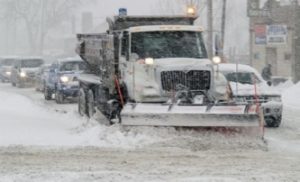
Photo: Snowplow in action.
Could Atlanta and much of the Deep South look like this by the end of the week? Well, maybe.